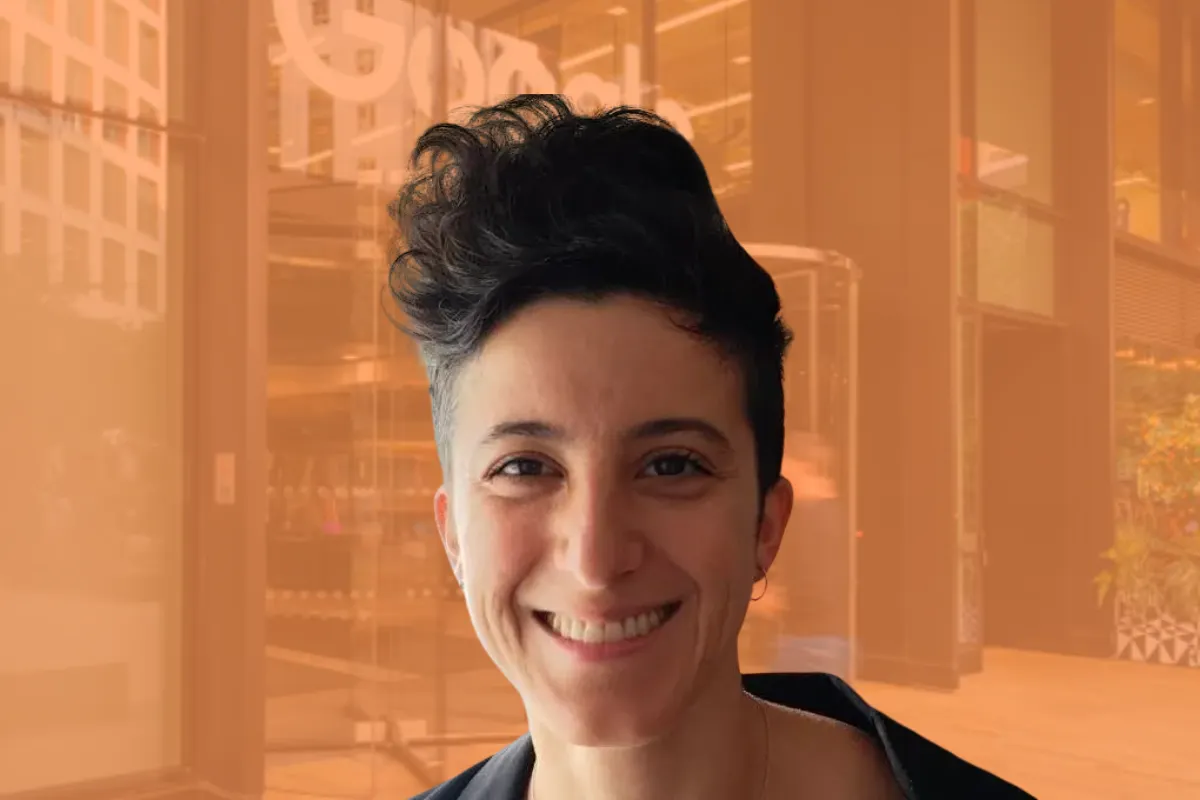
Sofia Liguori used to be an AI research engineer at Google DeepMind. But after three and a half years inside one of the world's most influential companies, she publicly resigned in recent weeks, published an open letter, and accused the industry of normalising military and surveillance applications of artificial intelligence. Here is her story.
In the latest episode of They Used To Be…, Ette Media’s new interview podcast series, Antoinette Lattouf speaks to Liguori, a former AI research engineer at Google DeepMind.
Liguori defied the tech behemoth’s gag clause to speak publicly about Google building military AI, including its classified AI agreement with the U.S. Department of Defence (Pentagon) in late April 2026. Project Nimbus - a billion-dollar contract signed between Google, Amazon, the Israeli government and the IDF was signed in 2021, but continues despite Israel’s well-documented crimes against humanity that increased after October 7.
“Google was warned in advance about the potential for this contract to facilitate human rights violations, and it was warned both internally and by an external consultancy firm, and the recommendation was to not provide AI tools and to include AI principles into the contract,” Liguori tells Ette Media from her UK base.
Even though Liguori’s worked in an entirely different department focused on optimal power flow, energy, and sustainability, she felt she was part of the company’s “ethics washing”, or the “nice face of the devil”.
“I lost my motivation to do my day-to-day job from inside such a company. I'm so disgusted by Google. And I also think that basically no good can be done there...no good technology can be developed from the inside of these companies,” she said.
Liguori explains how witnessing Israel's war on Gaza, learning more about Google's military contracts with the United States, and participating in internal employee activism forced her to confront questions she could no longer compartmentalise.
“I was watching a live stream genocide while experiencing motherhood for the first time… I kept thinking my company is complicit,” she recalls.
A series of failed attempts at accountability and dialogue with executives left her disillusioned.
Liguori also challenges some of the most common assumptions about AI, arguing that the greatest danger isn't necessarily when the technology fails, hallucinates or escapes human oversight, but when it works exactly as designed.
“The pattern that is emerging is giving away the technology with no restriction, no safeguards, and at the same time, and this is really important, giving away any monitoring power.”
Despite concerns about legal repercussions for breaching employment contracts that prohibit her from publicly criticising the company, Liguori says it is worth the risk and encourages others to do the same.
“We have a lot of power, and even just a single person speaking out and breaking the rules from the inside makes the difference,” she says.
“You can actually act, you can be vocal … There is a distinction between what is our perception of the boundaries and the real boundaries.”
Congrats to Sofia for having the courage to resign and speak out!
— Andreas Kirsch 🇺🇦 (@BlackHC) October 21, 2026
This is also very important:
Staff are scared to speak out about AI safety and its uses in warfare because their employment contracts prohibit them from publicly criticising the company.https://t.co/bECrdQ3WBO
Since Liguori’s public departure, employees in Google’s artificial intelligence division, reportedly checked their own contracts and found similar lifetime non-disparagement clauses and there has been internal disqueit since.
Days after Liguori’s chat with Ette Media, the Washington Post quoted a Google Executive telling employees that the non-disparagement clause would not be enforced for staff who had left the company.
“Fighting back matters, and when enough people stand together, change is possible,” Liguori said.
Watch Sofia Liguori’s chat on Apple here and on YouTube here. You can also find it wherever you get your podcasts.