Table of Contents
By Antoinette Lattouf, Anushri Sood, Dr Richard Bean and Jan Fran
This newsletter has been made available to free subscribers of Ette Media. The full episode is available to listen to wherever you get your podcasts or to watch Youtube. If you value this work and would like us to do more of it, please consider becoming a paid Ette subscriber. Your support is what allows us to do the work we do.
An exclusive data analysis of interviews conducted on ABC’s flagship daily current affairs show 7.30 over a four year period highlights how the public broadcaster echoes the Australian government’s views and alliances on foreign policy - despite mounting evidence of grave abuses of power, crimes against humanity, and ongoing breaches of international law. This is particularly prevalent when it comes to interviews with Israeli guests.
Ette Media, in partnership with mathematician and data analyst Dr Richard Bean, reviewed forty-two interviews and analysed the transcripts from the 7.30 programme between mid-2022, when Sarah Ferguson began her stint as host, until the end of August 2026.
We narrowed our parameters to interviews conducted with guests from active conflict zones, including Russia, Ukraine, Iran, Lebanon, Palestine and Israel.
We found representatives from allied countries, such as Israel, were far more likely to be given airtime, far less likely to be challenged on particular issues despite their relevancy, and far more likely to be supportive of their respective government’s actions.
Conversely, countries not allied with Australia were less likely to get airtime, were asked to ‘condemn’ acts of violence, challenged about ‘propaganda’ - and in the case of Russia, interviewees were almost exclusively anti-government.
Across the 42 interviews, we observed a difference in tone, language and questions depending on whether the guest was from an allied country or not, as well as a deference reserved for officials from allied countries, such as Ukraine and Israel - even when interviewee answers and talking points clearly contradicted credible and accessible evidence.
Our findings go to the heart of the ABC’s Editorial policy to “not unduly favour one perspective over another” and “Ensure that editorial decisions are not improperly influenced by political [interests].” They also speak to the ABC Ombudsman’s limitations in assessing complaints of bias.
Why conduct this analysis now?
Over the last few years many of our listeners, subscribers and social media followers have shared links and commentary on various 7.30 interviews, particularly those relating to active "conflicts" in the Middle East.
In some cases, we’ve been asked to share our thoughts on these interviews. It’s difficult to get a fair or comprehensive picture from just one or two disparate conversations, which is why we decided to review all interviews conducted by Ferguson with guests from Russia, Ukraine, Iran, Lebanon, Palestine and Israel.
Ukraine and Russia
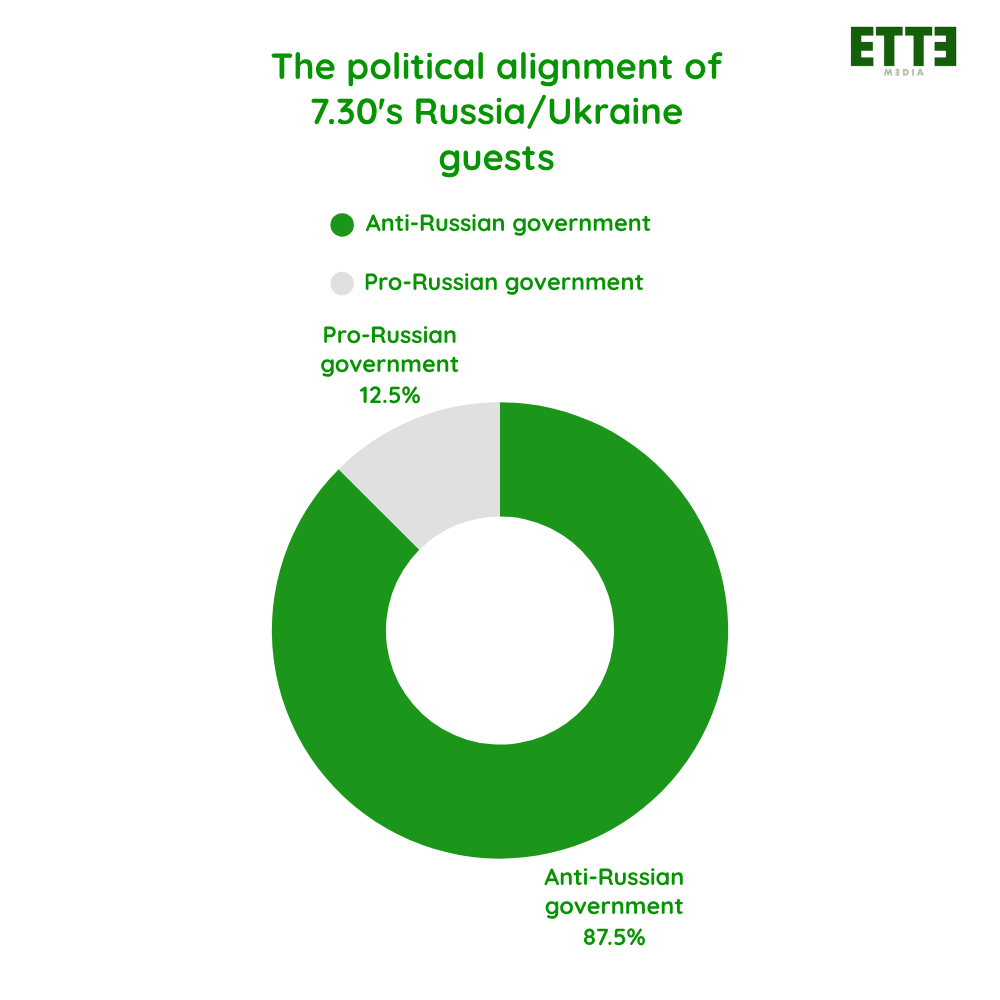
Since July 2022, four guests from Ukraine and four guests from Russia appeared on 7.30. Although the number of interviews was the same, the primary difference was that all interviewees from Ukraine were government officials or ambassadors in lockstep with the Ukrainian government, whereas three-quarters of Russian interviewees were vocal critics of the Russian government, including an exiled journalist.
In other words, seven out of eight voices in the context of the Russia/Ukraine conflict, were anti Russian government.
While we are not necessarily suggesting this ratio be any different - Russian leader Vladimir Putin is wanted for war crimes, continues to unlawfully and violently attack Ukraine and oversees repression in Russia - it’s important to note the perspectives Australians hear from and how this is unevenly applied to other countries committing atrocities.
Deference for Ukraine, disdain for Russia
Across the eight interviews on the Russia-Ukraine war, the language, tone and questions asked of Russian and Ukrainian guests is consistent with the Australian government’s view that a “unilateral, illegal and immoral war [is being waged] on Ukraine” by Russia.
Referring to the Russia-Ukraine war, Ferguson asked Ukraine’s ambassador to Australia Vasyl Myroshnychenko if he thought:
“Western countries, including Australia, really accept that this is a battle on their behalf rather than on behalf of the Ukrainian people,”
…suggesting a war against Ukraine is a war against all democracies, including Australia.
In another interview with a Ukrainian official, Ferguson asks:
“Australia has given funds to Ukraine; it has announced further sanctions today. What more can Australia do for Ukraine?"
This is in contrast with Ferguson’s interview with Russia’s Ambassador to Australia, Alexey Pavlovsky, where she opened the interview with the question:
“You're here in Australia enjoying the benefits of a free and open society; how do you live with yourself representing the repressive, dictatorial Putin regime?”
We also identified four instances where Ferguson accused Russia of “propaganda”, including to Ambassador Pavlovsky:
“If you're just going to repeat Russian propaganda tropes from the past, I'll ask you to move on.”
Ferguson also brought up references to Russian propaganda with Ukraine’s Ambassador, asking:
“How is Ukraine preparing for how Russia will use propaganda around messaging about an upcoming UN meeting?”
She also said:
“We are not denying Russia uses propaganda.”
Importantly, Ferguson's line of questioning is also consistent with reports from international law experts and humanitarian organisations that credibly accuse Russia of committing crimes against humanity, including the deliberate targeting of civilians, the forcible transfer of children and the withholding of humanitarian aid.
The Russian ambassador is correctly held to account over his leader’s abysmal human rights record, however …
Not all wanted war criminals are treated equally
Vladimir Putin is wanted by the International Criminal Court (ICC) over alleged war crimes linked to Russia's invasion of Ukraine. Israeli Prime Minister Benjamin Netanyahu is also wanted by the ICC, over allegations of war crimes and crimes against humanity linked to Israel’s genocide in Gaza.
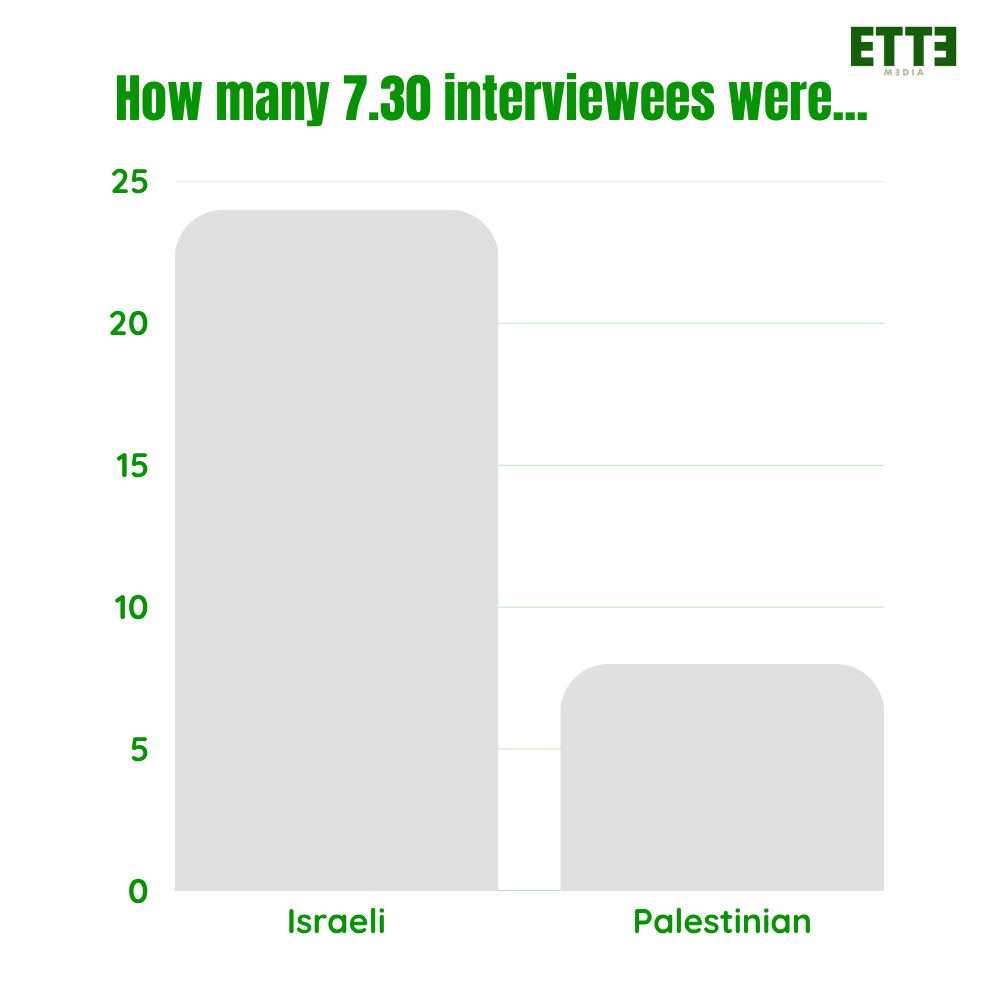
Despite that parallel, ABC's 7.30 aired 24 interviews with Israelis, almost all of them broadly supportive of Netanyahu. In other words, not only were Israeli perspectives aired six times as often as Russians’ - they were overwhelmingly pro-government. In contrast, Russian perspectives were overwhelmingly anti-government.
Two ICC arrest warrants, two different interviews
The interview with Ambassador Pavlovsky took place around the time the ICC issued arrest warrants for Putin. Remember, the first question Ferguson asked him was: how do you live with yourself?
Similarly, after ICC officials requested arrest warrants be issued for Netanyahu, Ron Dermer, who is a trusted advisor of Netanyahu, was interviewed on 7.30.
This was the first question put to him:
“One hundred and twenty-four countries are signed up as parties to the International Criminal Court. Now if the judges issue warrants for the arrest of Mr Netanyahu and Mr Gallant, the authorities in those countries would be obliged to arrest them. How could Mr. Netanyahu continue as Prime Minister in those circumstances?”
Even though the context regarding their respective leaders is similar, questions to one official are immediately adversarial, emotive and admonishing while questions to the other are administrative and prosaic. We believe this contrast highlights the gravity of the arrest warrants in the former example and downplays it in the latter.
This mirrors our government’s approach to the two countries. Canberra has consistently condemned and imposed sanctions on Russia and while it has criticised Israel over certain actions, it continues to maintain strong diplomatic and defence ties to the country.
Israel and Palestine: who do Australians hear from?
Israelis were interviewed three times as frequently (24) as Palestinians (8).
Israeli guests included ambassadors, government ministers, former prime ministers, former defence ministers, and two families of hostages. The vast majority were supportive of Israel's government with some caveats, including criticism from a former Prime Minister who hailed from an opposing political party to Netanyahu’s Likud Party.
Ferguson certainly asked Israeli officials some direct and tough questions, including:
- "What do you think happens to a child who is suffering malnutrition?"
- "Will Israel keep assassinating Ayatollahs until you get a leader that you approve of?”
- "For an army that says it doesn't target civilians, how is it that you've killed so many of them?"
But compare this with the approximately four hours of cumulative airtime given to Israeli officials to repeatedly deny that starvation is being used as a tool of war, dismiss the flotilla activists' aid mission as a "provocation," insist that "humanitarian aid can be delivered very easily," and outright reject allegations of genocide. ("The accusations made against Israel for a long period of time that we committed a genocide in Gaza, that is not true").
An exchange such as the one below did not lead to questions about how the Israeli minister lives with himself.
Ferguson: "Do you accept, first of all, that it is a war crime to target civilians?"
Ron Dermer, Israeli minister: "If you're targeting wilfully, of course, but we just haven't done it."
An exchange such as the one below did not lead to accusations of propaganda.
Ferguson: “Is there a limit to what international law allows in terms of Israel's self-defence when it comes to a number of casualties?
Mark Regev: "Of course. Of course. Israel is trying to keep the number of civilian casualties to a minimum… as a democratic society, we don't target the Gazan civilian population. We'll do our best to minimize any civilian casualties."
This interview was broadcast on October 26, 2023. Since then, Israel has continued to invest heavily in narrative control, including approving a billion dollar addition to its national budget for “hasbara” in April this year. Yet, at no point was an Israeli guest asked about Israeli propaganda.
“Savage” and “horrific” vs. Do you “condemn”?
Across the 42 interviews, Ferguson repeatedly used the terms “savage” and ‘’horrific”. However, they were used exclusively to describe the October 7 Hamas attack on Israel.
Use of the terms "savage" and "horrific".
This use of language is mirrored in newsrooms around the world. In his book, How to Sell a Genocide, author and American journalist Adam Johnson looked at so-called US “liberal media” reporting on Gaza between October 2023 and October 2024 and found that the word “savage” was used 16 times for the killing of Israelis, but never for the killing of Palestinians. The word “slaughter” appeared 120 times in relation to the killing of Israelis, but only once for Palestinians. “Massacre” appeared 344 times in relation to Palestinians killing Israelis, but never for Israelis killing Palestinians.
The word “condemn” was also used exclusively by Ferguson, but this time only directed at Palestinian guests.
On October 30, 2023, Ferguson asked Majed Bamya, Ambassador-Deputy Permanent Observer of the State of Palestine to the UN:
“As a representative of Palestinians at the UN, do you condemn Hamas's attacks on October the 7th?”
Also that month, Ferguson interviewed Dr Mustafa Barghouti, the leader of the Palestinian National Initiative, a political party headquartered in the West Bank. Barghouti is a well-known, long time campaigner for non-violent resistance, yet this is how the interview commenced:
“I've yet to see you categorically condemn Hamas's savage actions. Does your anger at Israel's long occupation and blockade of Gaza make it impossible for you to condemn them?”
Examples of Palestinian guests being asked to condemn violence.
By January of 2025 an estimated 75,200 Palestinians had been killed, and over a million were maimed, starved, and forcibly displaced, while being subjected to unprecedented artillery shelling.
Yet none of the near-dozen Israeli officials interviewed since were asked whether they condemned the actions of the state of Israel or Benjamin Netanyahu.
Questionable questions
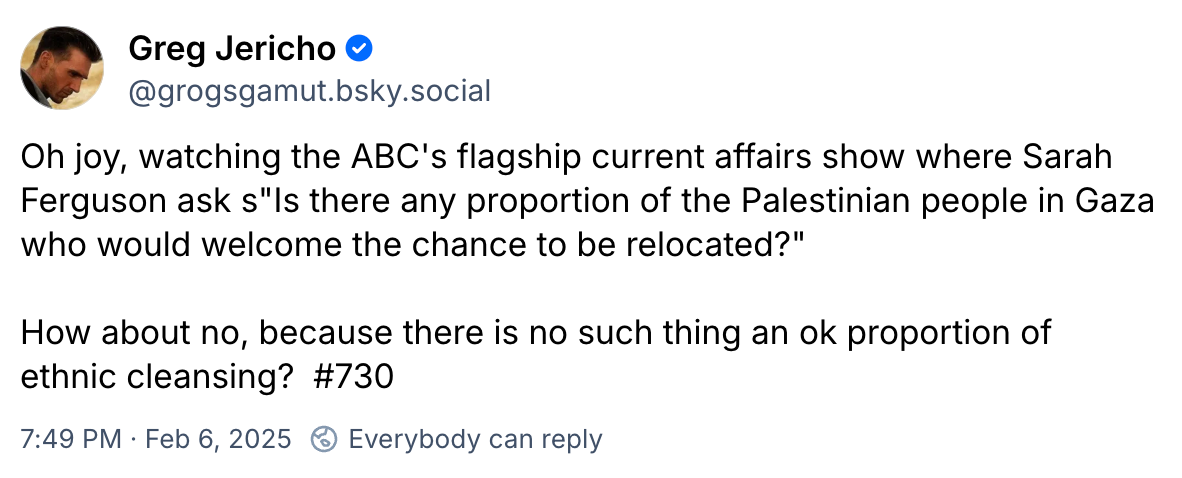
In February 2025, Ferguson interviewed Dr Varsen Aghabekian, the Palestinian Authority's Minister of State for Foreign Affairs, asking:
“Is there any proportion of the Palestinian people in Gaza who would welcome the chance to be relocated?”
Dr Aghabekian responded:
"These are human beings, after all…they are sick and tired of occupation…after being subjected to 15 months of bombardment, this is unimaginable.”
We found this to be a jaw-droppingly prosaic question. It came a year-and-a-half into Israel’s horrific assault on Gaza and the word “relocated” was doing some seriously heavy lifting.
It’s worth noting that the United Nations defined ethnic cleansing in its 1994 Commission of Experts report as a policy aimed at removing a civilian population from an area through violent and terror-inspiring means. (S/1994/674)
Ferguson’s question asked in a different way, with the same meaning, could be: “Is there any proportion of the Palestinian people in Gaza who would welcome the chance to be ethnically cleansed?”
The last 7.30 interview with a Palestinian was in October 2025, when a so-called ceasefire was brokered. Since then, more than 1,200 Palestinians in Gaza have been killed and Israel has continued to bomb the region.
Additionally, state-sanctioned violence by settler-terrorists in the West Bank are at record highs. Since its last interview with a Palestinian, 7.30 has conducted a further ten interviews with Israeli guests who were given the opportunity to speak about Iran, Palestine and Lebanon.
Iran and the interview that went viral
Across the assessed period, 7.30 conducted two interviews with Iranian experts and representatives, both in 2026.
The more recent of the two was with Mohammad Marandi, a University of Tehran academic and a supporter of the Iranian government.
It opened combatively:
Ferguson: "What right does Iran have to hold the rest of the world to ransom by preventing oil shipments passing through the Straits of Hormuz?"
Marandi: "Excuse me, I think it was the United States that waged the war against Iran and your government supported it. They said nothing in condemnation. The United States slaughtered our children. The United States murdered our leaders. The United States destroyed our critical infrastructure along with the genocidal Zionist regime that your government loves and so you're in no position to critique Iran."
Marandi reset the parameters of the conversation, framing Ferguson the same way she framed him: as a representative of her government (whether you believe that’s fair or not is another matter). Towards the end of the interview he says:
"Since you are Australian and you are affiliated to the state, and since you’ve been supporting genocide in Gaza, I don’t expect anything from you."
We believe this interview went viral because Marandi (rightly or wrongly) was able to frame “us,” based on our alliance with the United States, as the bad guys. This presents a serious question for newsrooms conducting foreign policy interviews in the shadow of Donald Trump. Whatever moral high ground we believe we have is fast eroding with every autocratic decision Trump makes. Audiences can see this and if broadcasters and newsrooms do not adjust their approach, they risk losing audience trust even more than what they already have.
The only other Iranian interview was with foreign ministry spokesperson Esmaeil Baghaei, in March 2026.
Partway through, Ferguson asked a question about the case of Iranian women's footballers who had sought asylum in Australia. Baghaei disputed the framing and insisted the players had been “coerced” into seeking asylum.
Ferguson challenged this assertion and called his claim “outrageous”. She demanded evidence that the Australian government had coerced the women in any way and asserted it had been their free choice.
This was one of the most forceful pushbacks from Ferguson in any of the 42 interviews assessed and it came while defending the Australian government's own conduct – whether or not that was her intention.
This raises a genuine question: does the ABC see part of its role as defending the positions of the Australian state, rather than holding an even line across all of them, driven by evidence?
It's also worth acknowledging the practical difficulty of securing interviews in Iran. Ferguson noted on air that it had taken a week to lock in the Baghaei interview, and Iran has in recent months moved to criminalise contact between journalists or citizens and foreign media, though this appears not to extend to government officials.
We asked the ABC how many attempts it had made to secure interviews with Iranian officials over the assessed period and did not receive a direct answer.
Lone interview: Lebanon
Since October 07 2023 almost 9,000 Lebanese people have been killed, tens of thousands injured and more than one million displaced, yet between mid-2022 and mid-2026 only one Lebanese official - Lebanon’s Minister of Public Health, Dr. Firass Abiad - was interviewed on 7.30.
The interview took place after a particularly deadly Israeli attack, in which 500 Lebanese people were killed in a day. Ferguson asks Abaid a series of questions including:
"Now, we understand that there were nearly 500 deaths yesterday and more than 1,500 people injured. Are they the latest figures? Is there any update?"
"Just before I ask you about what may come next, we have seen pictures of hundreds of thousands of people fleeing from the south. Are you able to accommodate those people in the centre or the north of the country?"
“Now what preparations are you making for further attacks … What can you do to prepare your civilian population for that?”
Abiad replied:
"Well, I shouldn't be preparing for civilian casualties, to be honest, in any conflict. These are the international humanitarian laws, but anyway, I think what we have been doing is raising the capacities of hospitals."
Far from using terms such as "savage" or "horrific" to describe the slaughter of 500 Lebanese people in a single day, Ferguson's interview approach is administrative. How is the system coping? Are you able to accommodate those fleeing? What can you do to prepare your civilian population for more attacks?
The full interview with Lebanon's Firass Abiad.
There's an inevitability baked into such questions, an assumption that further escalation is simply going to happen, and that the onus sits with Lebanon to prepare for it rather than with Israel to stop it.
That lone interview aired in September 2024. More than two years on, there hasn't been a single follow-up interview with a Lebanese official from Lebanon, despite Lebanon having since been invaded, with the south unlawfully occupied by Israel.
Since March this year, the IDF has killed 4,500 people in Lebanon, deeply affecting many in Australia's own Lebanese community, put at around 250,000 by the census and as high as 400,000 by community estimates.
Our media colleagues in Lebanon and Palestine
Also revealing is the absence of any questions put to Israeli officials by Ferguson about the Palestinian and Lebanese journalists their state continues to target and kill. Israel has killed more journalists than any other government since the Committee to Protect Journalists began collecting data in 1992.
In four years of interview coverage on 7.30, why hasn’t a single question been asked about fellow journalists killed?
We put this to the ABC but did not get a direct answer.
ABC’s response
Presented with all of our findings, the ABC did not accept our findings that its interviews mirror the Australian government’s stance rather than being guided by the weight of evidence and international law, or that it disproportionately airs the views of Israeli officials.
An ABC spokesperson said:
7.30 is one part of the ABC’s extensive coverage of the conflicts in the Middle East and Ukraine-Russia, which now comprises thousands of reports over a long period of time, and bringing audiences key interviews is just one element of its coverage.
Each day the 7.30 team seeks a variety of interviews, prioritising accountability interviews. They look widely and seek access to the appropriate figures based on the news of the day.
It is not possible to make a judgement on impartiality based on selected quotes or by comparing different interviews with different people on different subjects and at different points in a developing story. Each interview depends on the context, events of the day and the person being interviewed.
As 7.30 presenter, Sarah Ferguson’s role is to probe and challenge, elicit information, fact-check, and hold to account, on the fly, on live television. There is no harder task in journalism and she does it to an extremely high level. She is an independent, impartial and rigorous journalist who always seeks to unearth the facts and allow the audience to make up their own minds.
The ABC also pointed to five Ombudsman findings covering complaints about 7.30's interviews with Israeli and Iranian guests that concluded “no breach”. It also pointed to an extract of the Ombudsman’s finding in relation to Ferguson’s interview on 26 October 2023 with Israeli spokesperson Mark Regev.
“Ms Ferguson has conducted a range of interviews on the Israel Gaza conflict, presenting a broad and diverse range of relevant perspectives on events, over time”.
However, this finding was made almost three years ago and predates the bulk of the assessed period and the majority of the 42 interviews analysed.
Scope of the Ombudsman
ABC Ombudsman Fiona Cameron confirmed before the Royal Commission into Antisemitism and Social Cohesion that her office doesn't conduct broad editorial reviews across multiple pieces of content.
So while we appreciate that individual interviews are investigated for bias, it’s difficult to get a comprehensive sense of bias or an editorial breach when they’re reviewed in silos.
Examining individual interviews cannot capture a pattern that only becomes visible in aggregate: four hours of interview time given to Israeli officials to deny widely reported allegations of war crimes; 24 Israeli guests against a single Lebanese official across four years; one Iranian and one Russian interview met with the most forceful pushback in the entire sample; not one question about the journalists Israel has killed in Gaza and Lebanon; only Palestinians asked to condemn violence; space and deference reserved for allies' denials while non-allies were accused of “propaganda”.
The self-assessment also doesn't capture the ABC's own selective vocabulary. Its Ombudsman previously described Hamas's actions as "murderous depravity" - language never applied to the conduct of the Israeli government, which has killed more than 70 times more Palestinians, a conservative figure by some estimates.
And?
Our analysis focused solely on interviews by Ferguson and while we were critical of the way many interviews were conducted when compared to others, the broader issue we are critiquing does not lie with a single interviewer. Ferguson is among the most experienced interviewers in the country. Our analysis does not seek to raise questions about her impartiality but rather what impartiality truly looks like within a state broadcaster when the state itself is not impartial.
The ABC is funded (and at times wielded) by a government with its own political, diplomatic and foreign policy agenda, not to mention a government exporting F-35 fighter jet parts to Israel.
The ABC prides itself on being wholly independent of the government. Its funding should not - and in most instances does not - influence its journalism. However, when it comes to particular current conflicts in Europe and the Middle East, in guest selection, tone, approach, framing and questions, 7.30 mirrors, amplifies and - at times - defends the Australian government’s position at the expense of “accountability interviews” in pursuit of the truth. This is particularly prevalent with Israeli guests.
This signals to Australian audiences, not only whose voices matter - but crucially whose lives matter.
A note on methodology
We reviewed all publicly available material from the 7.30 archive between July 2022, when Sarah Ferguson became host, and mid-August 2026. We ran the interviews through a speech-to-text tool to generate transcripts, after which data analyst and mathematician Dr Richard Bean used an AI tool to identify and classify guests as representatives or experts connected to particular countries.
We watched every interview conducted during the period of our investigation, with representatives and spokespeople from Iran, Israel, Palestine, Lebanon, Russia and Ukraine and cross-checked them with corresponding transcripts. We cross-referenced our findings with ABC 7.30 and asked the program to identify any interviews we may have missed, and no gaps were brought to our attention.
In the interests of time and resources we did not include guests from the United States, of which there were more than 60 interviews in the assessed period but several were on topics not related to these geopolitical conflicts.
Antoinette Lattouf and Jan Fran are the co-founders of Ette Media, Anushri Sood is Ette Media’s senior journalist and Dr Richard Bean is a mathematician and data scientist.
ABC STATEMENT IN FULL
It is not possible to make a judgement on impartiality based on selected quotes or by comparing different interviews with different people on different subjects and at different points in a developing story. Each interview depends on the context, events of the day and the person being interviewed.
As 7.30 presenter, Sarah Ferguson’s role is to probe and challenge, elicit information, fact check and hold to account, on the fly, on live television. There is no harder task in journalism and she does it to an extremely high level. She is an independent, impartial and rigorous journalist who always seeks to unearth the facts and allow the audience to make up their own minds.
7.30 is one part of the ABC’s extensive coverage of the conflicts in the Middle East and Ukraine-Russia, which now comprises thousands of reports over a long period of time, and bringing audiences key interviews is just one element of its coverage. Each day the 7.30 team seeks a variety of interviews, prioritising accountability interviews. They look widely and seek access to the appropriate figures based on the news of the day.
7.30 interviews are regularly examined by the ABC Ombudsman in response to audience complaints of bias one way or the other and no breaches have been found. Some of the reports:
- ABC NEWS | 7.30 | Interview with Sharren Haskel | 8 June 2026 | No breach
- ABC NEWS | 7.30 | Esmaeil Baghaei interview | 19 March 2026 | No breach
- ABC NEWS | 7.30 | Amichai Chikli interview | 25 August 2025 | No breach
- ABC NEWS | 7.30 | Sharren Haskel interview | 19 June 2025 | No breach
- ABC NEWS | 7.30 | Mark Regev interview | 26 October 2023 | No breach This report found that “Ms Ferguson has conducted a range of interviews on the Israel Gaza conflict, presenting a broad and diverse range of relevant perspectives on events, over time”.
The ABC Ombudsman's 2024-25 report also addresses complaints about interviews: ABC Ombudsman’s Twelve-Month Report
It says: "Predominantly concerns arise from interviews with controversial guests, from unfolding news coverage that is perceived to lack broader context and from analysis which departs from the firmly held views of some in the audience. Complainants often express grave dissatisfaction with a news item, without considering relevant, broader coverage. The ABC’s critical examination of a diversity of perspectives across multiple platforms is sometimes lost to an audience member convinced of an ABC agenda one way or the other. The ABC has not always got it right, but mistakes have been few when considering the comprehensive coverage provided across multiple channels."